Rolling Library Ladders: Ready to Ship vs. Custom
A rolling library ladder turns a wall of shelves into something you actually use, and it does it without eating floor space. But before you can pick a finish or a wood species, there's one decision that determines everything else: do you need a ready to ship kit, or a custom one?
Almost everyone gets this backwards. They start with the finish and work down to the measurements, then discover their ceiling doesn't fit standard sizing. Start with your rail height instead. It takes two minutes and it answers the question for you.
Start here: measure your rail height
Measure from the finished floor to where the center of the rail will sit. That single number decides your path.
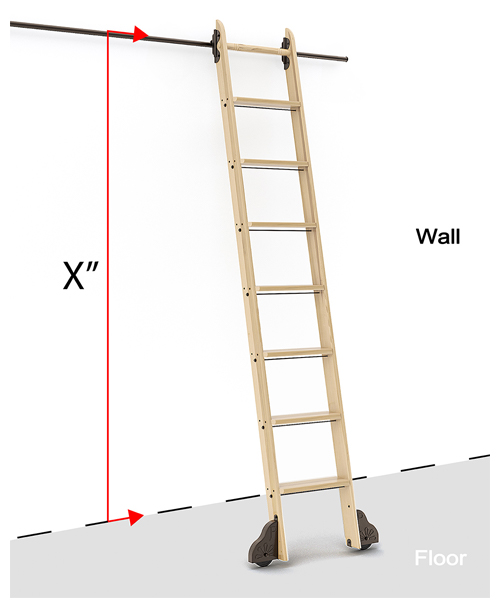
If your rail center lands at 91.5″–93.5″, 101″–103″, or 113″–115″: you fit standard sizing. Go ready to ship.
If it lands anywhere else, or your run turns a corner: you need custom.
Note that the ladder ends up roughly 5″ taller than the rail centerline. A 91″ rail height gives you about a 96″ ladder.
Ready to Ship vs. Custom at a glance
| Ready to Ship | Custom | |
|---|---|---|
| Lead time | 3–5 business days | 3–4 weeks (add a week for pre-finished) |
| Starting price | $811 | $1,342 |
| Ladder heights | 8′, 9′, 10′ | 8′ through 14′ (rail up to 163″) |
| Wood species | 3: Walnut, Maple, Red Oak | 9: Alder, Birch, Cherry, Hickory, Mahogany, Maple, Red Oak, Walnut, White Oak |
| Hardware finishes | 5: Black, Oil Rubbed Bronze, Satin Brass, Satin Nickel, Chrome | 6: all of those plus Hammered Antique Brass |
| Widths | 16″ or 20″ | 16″ or 20″ |
| Rail | 8′ or 12′ straight | Any length; straight or curved |
| Curved / cornered runs | No | Yes |
| Pre-finished option | No, ships unfinished | Yes, factory clear poly coat |
Ready to Ship Rolling Library Ladder Kits (from $811)
Shop ready to ship rolling library ladder kits →
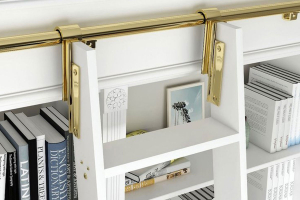
These ship in 3 to 5 business days. Everything arrives in one box: ladder, rail, rollers, brackets, end caps, and instructions. You configure it in six choices: hardware type, wood species, height, width, rail length, and bracket style.
What you're choosing from
- Hardware: Double Roller (captured on the track, non-removable, so it's more secure) or Rolling Hook (lifts off the rail so you can move it between sections or store it away)
- Wheel: Sunburst (traditional) or Contemporary. Both brake automatically when you put weight on the ladder.
- Wood: Walnut, Maple, or Red Oak
- Height: 8′, 9′, or 10′
- Width: 16″ or 20″
- Rail: 8′ (one continuous track) or 12′ (an 8′ and a 4′ plus a splice kit). Rails can be trimmed to length on site.
- Brackets: Horizontal or Vertical. Four included with 8′ rails, six with 12′.
Ladders ship unassembled and unfinished, which is deliberate: you paint or stain to match your millwork rather than trying to match ours.
Ready to ship is right for you if your ceiling is a standard height, your wall is straight, and you'd rather have the ladder next week than next month.
Custom Library Ladder Kits (from $1,342)
Shop custom library ladder kits →
Custom kits are built to your exact rail height, any measurement up to a 163″ rail centerline, which gets you a 14-foot ladder. Build time is 3 to 4 weeks.
What custom adds
- Nine wood species instead of three: Alder, Birch, Cherry, Hickory, Mahogany, Maple, Red Oak, Walnut, and White Oak in both quarter sawn and rift cut
- Heights from 8′ to 14′, built to your measured rail height rather than a size bracket
- Curved and cornered rail: 90° sections in 16″ or 30″ radius, and 135° in 30″ radius, so the ladder can turn a corner or wrap an island. (Curved rail requires the Swivel Roller upper fixture, worth knowing before you configure.)
- Hammered Antique Brass, which isn't available ready to ship
- Pre-finished ladders with a factory-applied clear poly coat, which adds about a week
- Bolt-on steam-bent handrails in Cherry, Hickory, Maple, Red Oak, Walnut, or White Oak
- Aluminum or adhesive grip tread covers for extra footing
A note on species and height: the tallest ladders narrow the menu. Above 12′, it's Cherry, Maple, and Red Oak only. Walnut and White Oak top out at 12′; Birch, Hickory, and Mahogany at 10′. If you have your heart set on a 14′ Walnut ladder, that's the one combination we can't build.
Beyond Quiet Glide, custom also covers Alta (aluminum and wood, contemporary), Putnam (the classic New York rolling ladder, polished brass), and Cotterman (steel, for commercial and industrial spaces).
How to measure: the numbers we actually need
Getting this right the first time is most of the job.
-
Rail height (the critical one). Floor to the center of the rail. Round up to the nearest inch. Not floor to shelf, not floor to ceiling. Floor to rail center.
-
Rail length. The full horizontal run you want the ladder to travel. Custom rail comes in 3′, 4′, 6′, and 8′ sections joined with splice kits, and can be field-cut. You need one fewer splice kit than you have sections. A 20′ run built from two 8′ rails and a 4′ needs two splices.
-
Bracket count. Straight rail wants a bracket every 32″. Take your total straight run in inches, divide by 32, round up, then add one. Ten feet of rail: 120 ÷ 32 = 3.75, round up to 4, add one, so 5 brackets. Each curved section needs 2 of its own.
-
Support rods. Any ladder over 8 feet needs one additional support rod per foot over 8. A 12′ ladder needs four.
-
Tread covers, if you want them: one per rung. An 8′ ladder has 7 rungs; each additional foot adds one, up to 13 rungs at 14′.
Not sure about your numbers? Send us your measurements and we'll spec the kit for you.
What's actually in a library ladder kit?
Worth being explicit, because "kit" gets used loosely and people often buy parts they didn't need.
Every kit includes
- The wood ladder (unfinished, or pre-finished on custom orders)
- Two bottom rollers with your chosen wheel style, both with automatic braking
- Two top guides in your chosen fixture style
- Rail, brackets, and end caps
- All mounting hardware and step-by-step instructions
In other words: a kit is the whole system. You don't need to add anything to get a working ladder. That's the part most people get wrong when they start shopping by individual part.
When you'd buy parts instead of a kit: you already own a ladder and you're replacing a worn wheel; you're extending an existing rail run; you're swapping brackets to change the mount. If that's you, we sell individual rails, wheels, and brackets separately.
If you don't have a ladder yet, buy the kit. It's cheaper than assembling the same components à la carte, and you can't end up one bracket short.
What about ladders that don't roll?
If you like the look but don't need the ladder to travel (a single tall bookcase, a closet, a pantry), a stationary ladder does the job for less. Our non-rolling library ladder kits hook over a rail and sit on non-skid feet. No track run to measure, no wheels to brake.
Still deciding?
Measure your rail height first. If it lands in a standard bracket and your wall is straight, ready to ship gets you there in under a week for less money. Anything else (odd height, a corner, a specific species) is custom, and worth the three-week wait to get right.
Or browse all library ladder kits and see everything side by side.