How to Choose a Spiral Staircase: The Complete Buyer's Guide
Everything you need to know before buying a spiral stair kit: indoor vs outdoor, diameter selection, code compliance, measuring, materials, installation, and budget.
Choosing a spiral staircase is more involved than picking a piece of furniture. The right kit depends on where it will be installed, how often it will be used, who will use it, what your local building code requires, and how much vertical space you need to span. Get any of those wrong and you'll end up with a beautiful staircase that doesn't quite work, or worse, one your inspector won't approve.
This guide walks you through every major decision: indoor versus outdoor, choosing the right diameter, understanding code compliance, measuring your space, selecting materials and finishes, and budgeting realistically. By the end, you'll know which spiral stair kit fits your project and what to verify before you order.
Spiral Stair Kit vs. Custom Spiral Stair: Which Should You Buy?
Before diving into diameters and code, a quick foundational question: kit or custom?
Spiral stair kits are factory-engineered modular systems that ship as a complete package: structure, steps, railing, and handrail in one or two boxes. They install in a weekend with common tools and cost roughly $3,000 to $8,000 depending on diameter, finish, and height. Variability between heights is handled through extra steps and an adjustable rise, so a single kit design covers a wide range of floor-to-floor measurements.
Custom spiral stairs are fabricated to exact specifications by a metal shop or stair builder. They allow unusual diameters, non-standard tread shapes, decorative ironwork, and integration with existing architecture. They cost roughly $10,000 to $40,000+ and require 8 to 16 weeks of lead time.
For 90% of residential projects, a kit is the right answer. You get Italian-engineered durability, consistent quality, and the ability to actually order the staircase today rather than waiting four months. Reserve custom for historic restorations, commercial projects with unique constraints, or genuinely unusual layouts.
Indoor vs. Outdoor: The First Real Decision
Spiral stair kits come in two fundamentally different construction types, and you cannot substitute one for the other.
Indoor spiral stairs use painted steel, powder-coated steel, or wood-and-steel construction. They're designed for climate-controlled environments and don't include the corrosion protection needed to survive exterior conditions. Installing an indoor kit outside is the single most common mistake DIY buyers make. Within a few seasons, you'll see rust, peeling paint, and weakened welds. The warranty won't cover it.
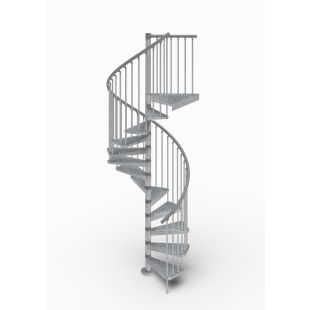
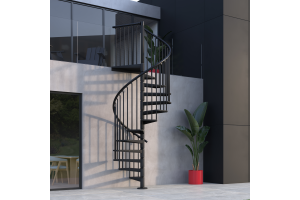
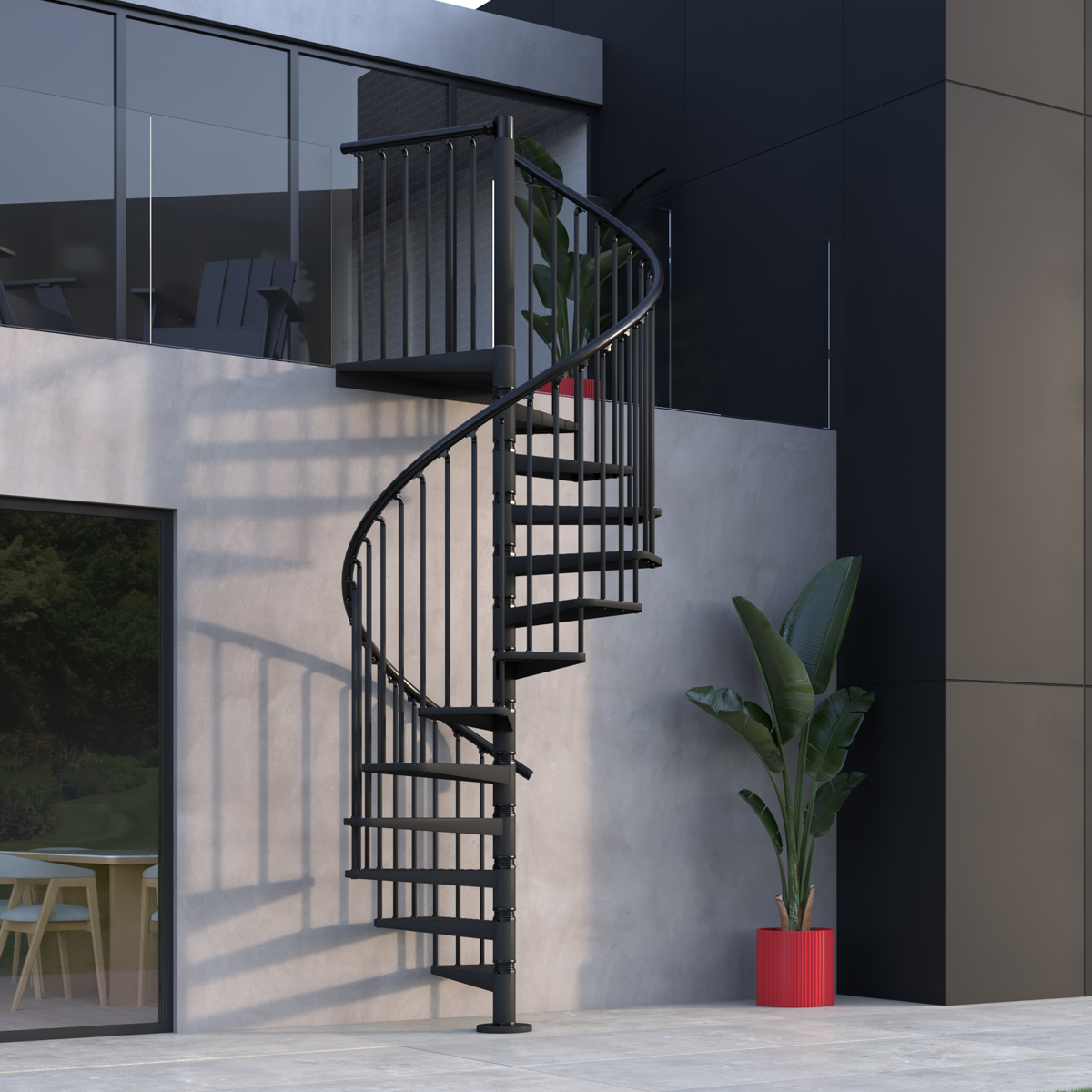
Outdoor spiral stairs use hot-dip galvanized steel construction. Hot-dip galvanization coats every surface (including hidden joints and welds) with a thick zinc layer that bonds chemically to the underlying steel. It's the gold standard for exterior steel protection and will perform reliably for decades in rain, snow, salt air, and UV exposure. Outdoor kits also typically use raised anti-slip patterns rather than applied strips, which handle wet conditions better and won't peel.
If your staircase will live on a balcony, deck, rooftop terrace, fire escape, or any space exposed to weather, you need an outdoor kit. If it will live inside a heated, dry building, an indoor kit gives you more aesthetic options at a better price point.
Choosing the Right Diameter
Spiral stair diameter is probably the most important sizing decision because it affects everything else: the floor opening you need, the tread depth you'll walk on, whether the stair meets code, and how comfortably you can carry things up and down.
Common kit diameters and their best uses:
41" (105 cm): Most compact. Requires a 43" x 43" minimum opening. Best for tight lofts, attic access, and secondary stairways where space is at an absolute premium. Tread depth is narrow, so daily use can feel cramped, better as occasional or supplementary access. Not IRC compliant for primary egress.
47" (120 cm): Compact. Requires a 49" x 49" minimum opening. The most popular compact size; fits most loft conversions, basement access points, garage stairs, and secondary additions. Tread depth is manageable for regular use but still tight for carrying furniture or laundry. Not IRC compliant.
55" (140 cm): Balanced mid-size. Requires a 57" x 57" minimum opening. A good middle-ground choice when you have a bit more room and want noticeably more comfortable treads than the 47". Well suited for moderately sized lofts, finished basements, and decks. Not IRC compliant.
63" (160 cm): IRC compliant minimum. Requires a 65" x 65" minimum opening. The smallest diameter that meets the International Residential Code's tread depth requirements, making it the practical choice when a spiral stair needs to serve as a primary staircase (subject to local code approval). Comfortable for daily use.
71" (180 cm): Most spacious. Requires a 73" x 73" minimum opening. The most comfortable kit size, with generous tread depth that approaches a conventional staircase feel. IRC compliant. Best for homes where the spiral stair is a design feature as well as a functional element, and where the larger floor opening is available.
A practical way to choose: measure the largest floor opening you can realistically create, subtract 2 inches on each side for clearance, and start there. If that puts you at 47", great. If it puts you at 65" or larger, you have the option of the IRC-compliant 63" or the more spacious 71". Don't try to squeeze a larger spiral into a smaller opening, the math is unforgiving and partial fits cause installation problems.
Understanding IRC Compliance and Local Code
This section confuses many buyers, so let's be precise.
The International Residential Code (IRC), specifically section 311.7.10 in most recent editions, sets minimum dimensional requirements for spiral stairs used in homes. The key requirements are:
- Minimum tread depth of 6-3/4 inches measured at a defined point
- Minimum 26 inches of clear walking width
- Maximum riser height of 9-1/2 inches
- Minimum headroom of 6 feet 6 inches
A standard 63" diameter kit hits all of these. A 47" or 55" kit doesn't meet the tread depth requirement at the measurement point, which is why we consistently call out IRC compliance starting at 63" diameter.
What this means practically:
If your spiral stair is the primary or only means of access to a habitable space (bedroom, living area, occupied attic, etc.), most jurisdictions require IRC compliance. This typically means you need a 63" or larger diameter.
If your spiral stair is secondary or supplementary access (a second way up to a loft that's also reachable by a conventional stair, access to non-habitable storage, decorative roof access, etc.), many jurisdictions allow smaller diameters because the IRC has exceptions for spiral stairs in specific use cases.
But, and this is critical, every local jurisdiction interprets and amends the IRC differently. Some require a building permit and inspection for any spiral stair installation, regardless of size. Some restrict spiral stairs to lofts under a certain square footage. Some require a licensed contractor for code-compliant installs.
Always call your local code enforcement office before ordering. Describe your project and ask three questions: (1) Do I need a permit? (2) What diameter is acceptable for this use? (3) Are there any local amendments I should know about? This 15-minute phone call has saved more spiral stair buyers from expensive mistakes than any other single piece of advice.
How to Measure Your Space
Three measurements determine whether a kit will work in your space.
Floor-to-floor height (H)
Measure from the surface of the lower finished floor to the surface of the upper finished floor. Do NOT measure to the underside of the joists or to the subfloor. Finished surface to finished surface. This number determines how many steps your kit needs.
Most spiral stair kits use 13 steps as a baseline (covering roughly 8' 10" to 9' 10" floor-to-floor) with options to add extra steps for taller heights. A typical kit accommodates floor-to-floor heights from about 6' 9" up to 12' 7" with extra steps. If your height exceeds the kit's maximum, you'll likely need an extra section of internal post. These are available as accessories but add cost.
Ceiling opening dimensions
Measure the existing or planned floor opening at the upper level, both length and width. The opening must be at least 2 inches larger than the stair diameter on each side. So a 47" spiral needs at least a 49" x 49" opening; a 63" needs at least 65" x 65"; a 71" needs at least 73" x 73". If you're cutting a new opening, allow some margin. Building exactly to the minimum makes installation difficult.
Headroom clearance
As you walk up a spiral stair, you need at least 6' 6" of vertical clearance at every step. The critical point to check is the step that passes under the upper floor edge, where the stair is exiting the opening. If your ceiling there isn't tall enough, you may need a larger floor opening to position the stair where headroom works, or a different solution entirely.
Sketch all three measurements before ordering. If you have any doubt, send your measurements to our team and we'll verify which kit configuration fits.
Materials and Finishes
Each product line uses different materials, which affects both aesthetics and long-term performance.
All-painted steel construction (Manhattan)
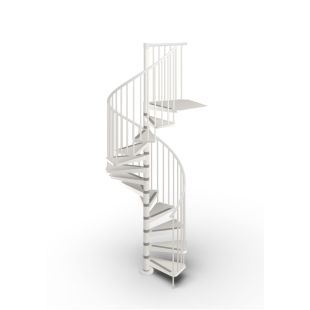
Painted steel steps, painted steel structure, painted steel railing. Cleanest, most contemporary look. The simplest construction and typically the most budget-friendly option. Available in white with gray accents or all black. Best for modern interiors, industrial-style spaces, and projects where the staircase is a functional element rather than a focal point.
Wood-and-steel construction (Denver)
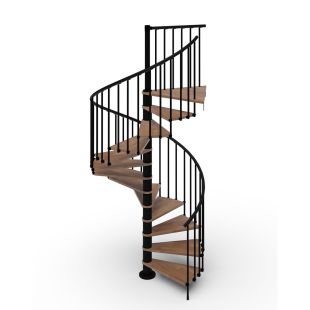
Solid beech wood treads (typically 1-5/8" thick) mounted on a powder-coated steel structure. The wood adds warmth and a more residential feel; the steel provides the structural backbone. Available in Natural or Walnut wood with White or Black steel. Best for traditional, transitional, and modern-organic interiors where the staircase is meant to be visible and appreciated.
Hot-dip galvanized steel construction (Naples Exterior)
Every surface coated with zinc through hot-dip galvanization, then painted with a weather-resistant top coat. Maximum corrosion protection for outdoor use. Available in galvanized-and-painted White 32 or Black 31. Best for any exterior installation.
A note on wood treads: solid wood does require some seasonal awareness. In very humid climates or unheated indoor spaces, wood treads can expand and contract slightly. Quality manufacturers (like the Denver line) use Finger Joint technology to minimize this, but if your space sees major humidity swings, the all-steel Manhattan or the galvanized Naples Exterior may be more forgiving.
Installation: Can You DIY This?
Modern spiral stair kits are designed for DIY installation. Most kits include a complete instruction manual, all required hardware, and step-by-step assembly diagrams. With basic tools (drill, level, ratchet, ladder) and one helper, a competent DIY-er can install a kit in 6 to 12 hours spread across a weekend.
Tasks that may require a professional:
- Cutting a new floor opening. If your project requires creating or enlarging an opening in an existing floor, hire a contractor. Joist modifications affect structural integrity and almost always require a permit.
- Electrical work. If lighting needs to move because of the staircase, hire an electrician.
- Permit-required installations. If your jurisdiction requires a licensed contractor or engineer's review, you'll need professional help regardless of your DIY skills.
The actual stair assembly itself, bolting steps to spacers, threading the central post, installing the railing, is well within DIY territory for anyone comfortable with assembling furniture or doing basic home renovation work.
Budget: What to Expect
Realistic spiral stair kit pricing in 2026:
| Kit Size | Typical Price Range |
|---|---|
| Compact (41" - 47") | $3,000 to $4,500 (standard 13-step) |
| Mid-size (55") | $3,500 to $5,500 |
| IRC-compliant (63") | $4,500 to $6,500 |
| Spacious (71", Denver only) | $5,500 to $8,500 |
Add 10 to 20% for premium finishes (wood treads, optional helical wood handrails), 5 to 10% for extra steps if your height exceeds the standard kit range, and a center post extension (~$200 to $400) for floor-to-floor heights above 10' 6".
Shipping for spiral stair kits typically runs $200 to $600 depending on distance and whether the kit ships in one box or two (larger diameters often ship in two packages for safer handling). If you're comparing against a custom spiral stair quote of $15,000+, the kit pricing should make the decision easy unless your project has specific custom requirements.
How to Choose Between Our Three Product Lines
If you've made it this far, the choice between Manhattan, Denver, and Naples Exterior should be clear, but here's the short version:
Choose Manhattan if you want an indoor spiral, prefer all-steel construction for its clean modern look, and want the most budget-friendly entry into the line. Available in 47", 55", and 63" diameters.
Choose Denver if you want an indoor spiral with the warmth of real wood treads, value the wider range of diameter options (41" through 71"), or specifically need a 71" diameter for primary staircase use. Available in 41", 47", 55", 63", and 71" diameters.
Choose Naples Exterior if your spiral stair will be installed outside, on a deck, balcony, rooftop terrace, or any exterior location. Hot-dip galvanized construction is non-negotiable for outdoor use. Available in 47", 55", and 63" diameters.
Final Checklist Before Ordering
Before you click "add to cart" on any spiral stair kit:
- Confirm your floor-to-floor height is within the kit's adjustable range, and identify any required extras (additional steps, center post extension).
- Confirm your floor opening dimensions meet the minimum required for your chosen diameter.
- Confirm headroom clearance at every step, especially the step exiting the upper opening.
- Confirm code compliance by calling your local code enforcement office before purchase.
- Plan your delivery and assembly. Spiral stair kits are heavy and bulky. Confirm you have a path from the truck to the installation point and a place to stage the parts during assembly.
- Verify your installation tools and helper availability. Most kits need a two-person installation, basic hand and power tools, and 6 to 12 hours of weekend time.
Get those six items confirmed and your installation will go smoothly. Skip any of them and you risk delivery surprises, code rejections, or a kit that doesn't quite fit.
Still have questions?
Our team can help you select the right diameter, verify your measurements, and walk through your specific project. Browse our complete selection of indoor spiral stair kits and outdoor spiral stair kits, or contact us to speak with a stair specialist.